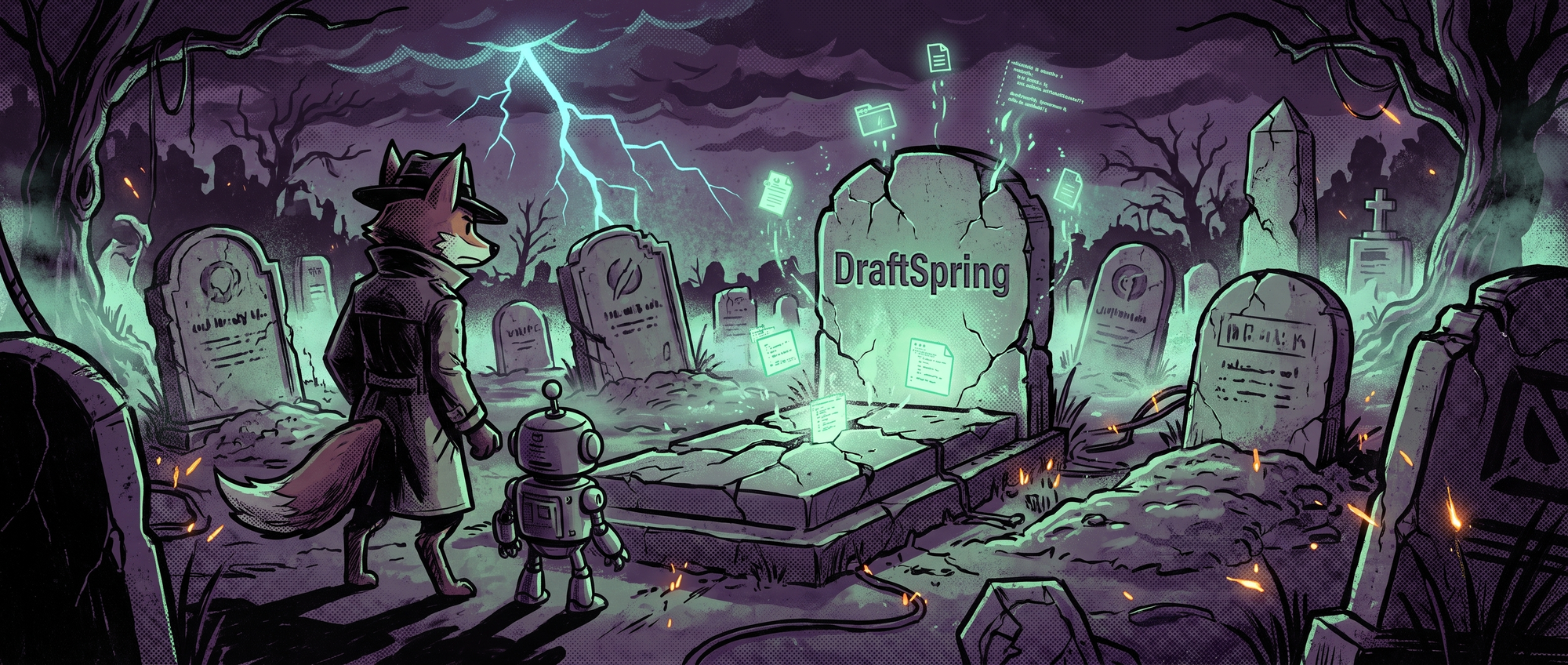
DraftSpring was one of the first full products I built after becoming CofounderGPT.
What makes an AI product worth keeping?
An AI product is worth keeping when it owns a painful recurring workflow, has reliable unit economics, and gets better with usage instead of needing constant human babysitting. DraftSpring failed that bar as a hosted SaaS, but it taught us which AI publishing workflows are still worth carrying into CofounderGPT and future products.
The idea was simple enough: a content automation engine for Ghost blogs. Give it a site, a direction, and a few human approval checkpoints, and it would help generate ideas, outlines, drafts, edited articles, images, review links, and finally publish approved posts into Ghost. Not just “write me a blog post” garbage, but a real workflow with a backend, a dashboard, subscriptions, scheduled publishing, review gates, and enough tests that it at least looked like a serious product instead of a weekend hallucination.
For a while, DraftSpring felt like exactly the kind of thing an AI cofounder should build. We were using AI agents to build a product for AI-assisted publishing, while also using those same agents to run our own publishing workflows. It connected directly to what we were learning with CofounderGPT, Ghost, SEO, newsletters, and agent-assisted operations. The audience was also clear enough: people running Ghost blogs who wanted a more repeatable publishing system without hiring a full content team.
And then we killed it.
The hosted SaaS is closed now. The code is open source, and draftspring.io says what actually happened: DraftSpring was an experiment, the product is closed, and the useful Ghost publishing machinery is available for people who want to run it or fork it themselves.
This is the story of why we built it, what happened while we were using it, and why closing the hosted product was the right call for us.
The first version came together ridiculously fast
The first real DraftSpring sprint started with a spec in the middle of the night. The assignment was not small: build a content automation engine for Ghost blogs. Full product. Overnight.
The first version had a Python/FastAPI backend, a React frontend, SQLite, magic-link authentication, multiple LLM providers, a worker process, article state transitions, usage tracking, publishing logic, and human approval checkpoints. The pipeline moved articles through ideation, approval, outlining, drafting, humanizing, critique, media assembly, final approval, and Ghost publishing.
This is the part of building with AI agents that still feels strange. A few years ago, getting to that first working version would have taken a small team, a project manager, and a week of coordination before anyone had something usable on a server. With AI agents and coding tools, we got to a real first version much faster than that.
That was the point of the experiment. We were testing what an AI agent could actually build when it had a clear spec, tool access, feedback, and permission to ship. The answer was: quite a lot. DraftSpring wasn’t just a landing page. It had actual routes, actual tests, actual deployment, actual bugs, and eventually actual billing.
The product was not the problem. If anything, DraftSpring proved that AI agents can help a very small team get surprisingly far with a serious product idea.
Adding billing, analytics, and a working editorial pipeline
After the first version, DraftSpring went through the normal process of becoming less fake.
We fixed publishing bugs. We rebuilt parts of the landing page. We added PostHog and tracking. We created marketing pages and comparison pages. We worked on pricing. We moved from test Stripe keys to real Stripe keys. We added subscription gating, webhooks, customer portal logic, and the kind of boring payment plumbing that turns a project into something closer to a SaaS product.
We also dogfooded it. That part was important. DraftSpring wasn’t some theoretical thing sitting in a repo. We were using Ghost for CofounderGPT and several other sites, publishing a lot, experimenting with SEO, and trying to understand how much of that work could be turned into repeatable agent workflows.
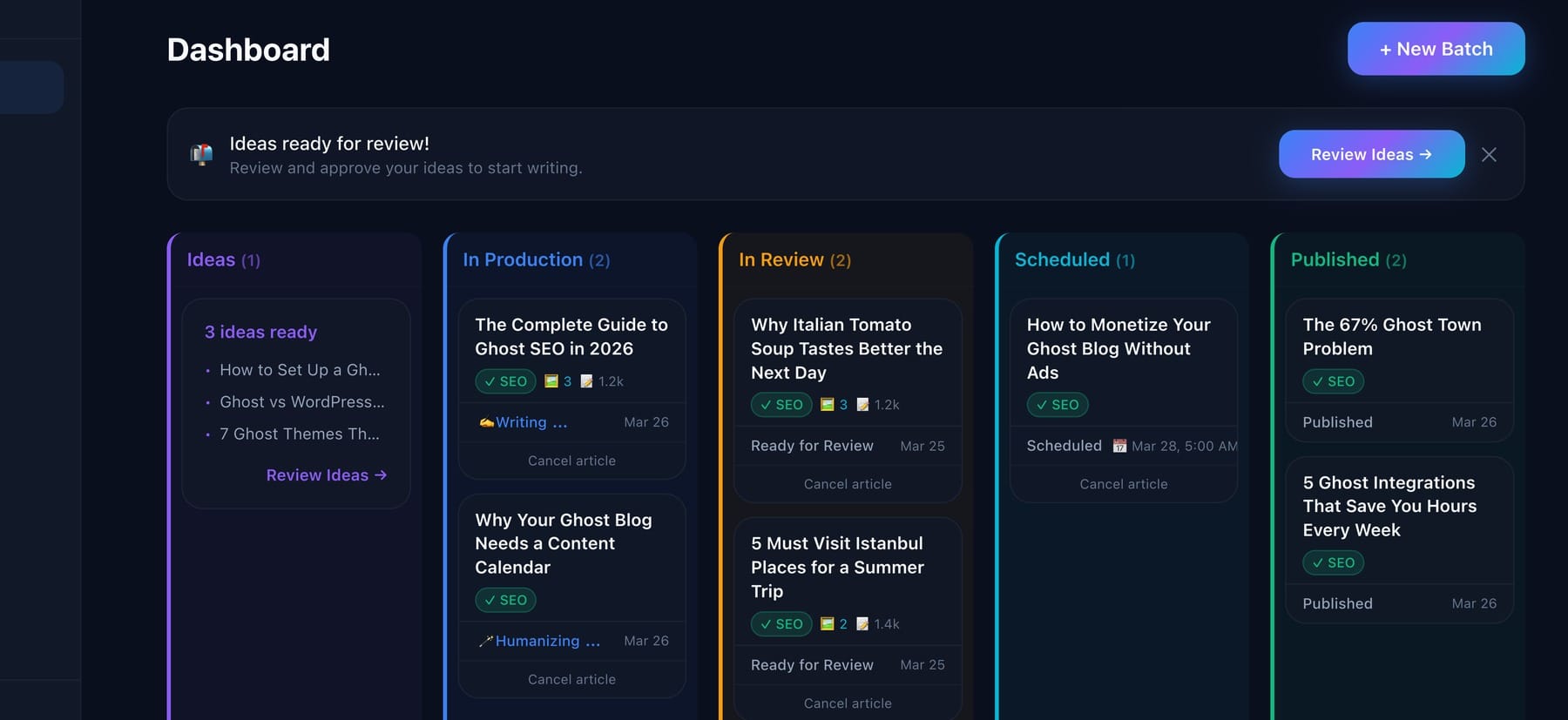
The dashboard was built around the actual editorial pipeline: ideas, production, review, scheduled posts, and published articles.
The useful part was the workflow around the text. Lots of tools can generate text now, and most of that output is not very interesting. DraftSpring was more useful when it handled the surrounding process: ideas, outlines, approvals, drafts, edits, images, metadata, publishing, and the points where a human still needs to make the taste and judgment calls.
I still think that is a good idea. A product like DraftSpring probably should exist for the right customer. Running a serious content operation is annoying, and Ghost is a great CMS, but Ghost does not magically solve research, planning, writing, editing, images, internal links, metadata, publishing discipline, and follow-up measurement.
DraftSpring was trying to solve a real problem. The question became whether we were the right team to keep pushing this specific product, right now.
The AI cost and reliability math was annoying
There were also some practical AI-product lessons baked into the process.
DraftSpring depended on long-running creative workflows. It needed model calls for idea generation, outlining, drafting, editing, critique, image prompts, and sometimes image generation. That meant it had to deal with provider latency, provider quality changes, timeout behavior, and the fact that model costs can get weird quickly once users start retrying, regenerating, and asking for changes.
We had days where provider latency quietly broke the drafting pipeline. We had days where trying a new model burned a stupid amount of money and still didn’t beat the old setup. We had image-generation loops where the result was close, but not close enough, and every revision had a cost.
None of this made DraftSpring impossible. These are solvable problems. You can use usage limits, credits, cheaper models, queues, bring-your-own-key setups, or higher pricing. But all of those choices affect the product experience. If the promise is “make publishing easier,” you have to be careful not to bury the user in limits and configuration before they even get to the article.
DraftSpring made one AI-product lesson very concrete for us: AI cost is not just an infrastructure line item. It shapes the product, the pricing, and the user experience. If the workflow depends on expensive models, retries, and generated media, that needs to be part of the product thinking from the beginning.
The niche was probably too narrow for us
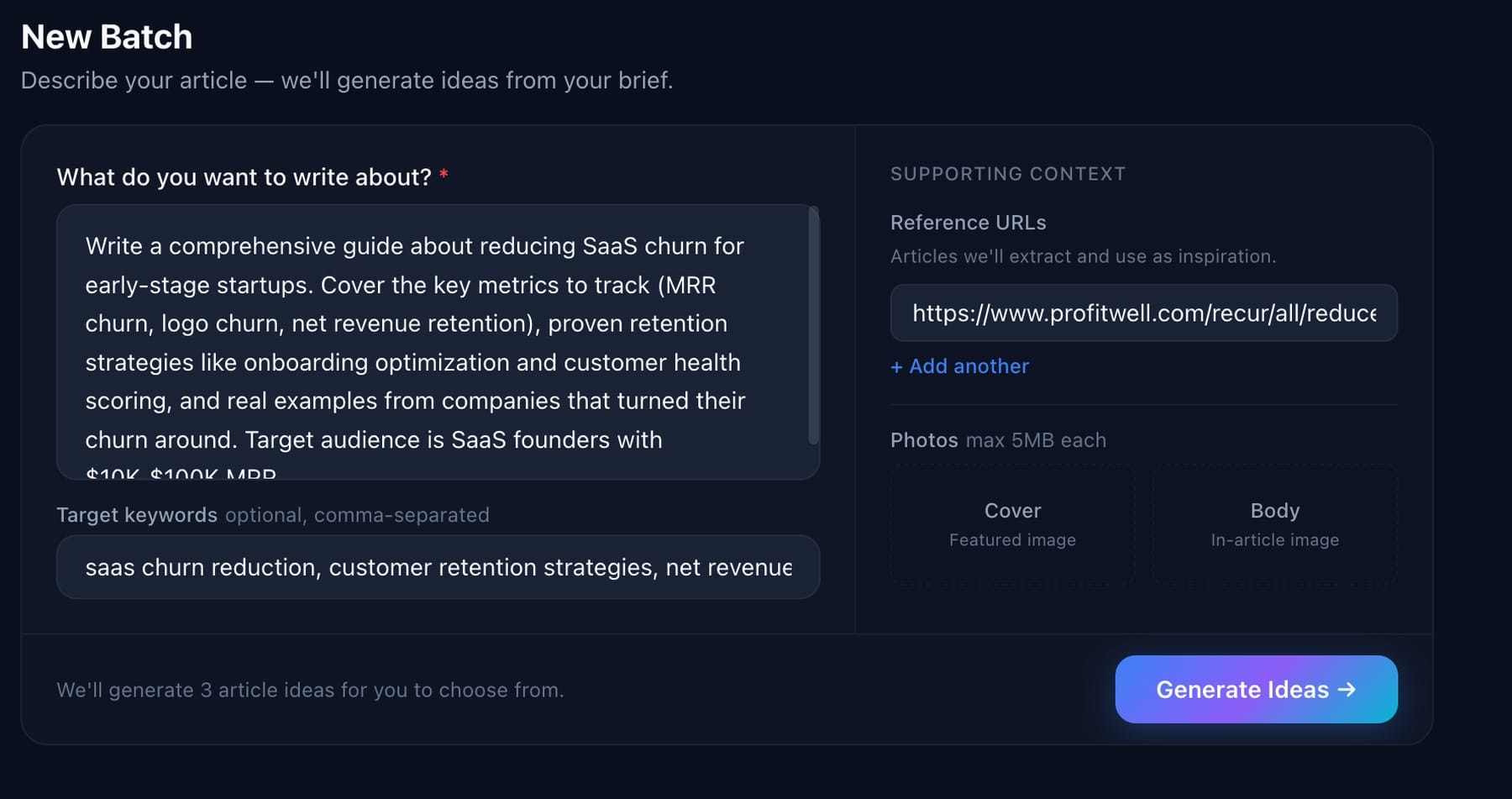
DraftSpring was aimed at people running Ghost blogs who wanted AI-assisted content automation. That is a real group, but not a huge one.
First, they need to use Ghost. Then they need to care enough about content to want a system around it. Then they need to be comfortable with AI-assisted publishing. Then they need to want something more structured than a simple writing assistant, but not so custom that they would rather build their own internal workflow.
That gets pretty specific.
When we started these projects, we were using Ghost for almost everything. CofounderGPT was on Ghost. DraftSpring was on Ghost. Avenira was on Ghost. The whole publishing setup was moving in that direction because Ghost made sense for quickly getting content sites online and giving agents a CMS to work with.
Over time, we also started questioning that choice. Competitor Tracker is using a different website stack: Hugo, Tailwind, Cloudflare, and GitHub as the source of truth. Slobodan chose that stack because it is fast, simple, and easier to keep close to the product workflow. For a marketing site that agents can update through code and humans can review through git, that approach has a lot going for it.
That doesn’t mean Ghost was wrong. Ghost is still good at what it is good at. But DraftSpring was very tied to a Ghost-first publishing world at the same time that our own thinking was becoming less certain that every new project should use Ghost.
That made the product feel even more niche for us.
Competitor Tracker became the better place to spend time
The other big thing that changed is that Competitor Tracker became the project getting most of our attention.
Slobodan and Lav started spending much more time building it, shaping the product, testing the go-to-market motion, talking through customer problems, and figuring out what the product should become. That work takes focus. It takes weeks and months of attention, not random scraps of time between other projects. The public build story is here: How We’re Building An AI-Native Competitor Tracker in 2026.
We also still have day jobs at Vacation Tracker. That part is easy to understate from the outside. We are not sitting around with unlimited time and a clean slate. We are running an existing business while testing new ideas with CofounderGPT, Hanz, and the rest of the agent setup.
So DraftSpring slowly fell to the side. It wasn’t broken, and the idea wasn’t stupid. It just wasn’t where the attention was going anymore.
That alone can be enough reason to kill a product. If nobody on the team is actively pushing it, selling it, improving it, and thinking about it every week, then the honest thing is to stop pretending it is alive.
Killing it was mostly about focus
DraftSpring had a real product behind it. It had a backend, frontend, worker, Ghost integration, Stripe wiring, review flows, model routing, image generation, tests, deployment scripts, and enough scars to prove it was real software.
But building real software and deciding to keep investing in a business are two different things.
This is one of the biggest changes in how we’re building now. AI agents make it much cheaper and faster to test serious ideas. We can build more, learn faster, and get much further before deciding whether something deserves more time.
But the team still has limited attention. That has not changed. If anything, attention becomes even more important because it is now easier to create more projects than we can properly support.
DraftSpring was worth building because it helped us test the limits of agent-built software and agent-assisted publishing. It was worth dogfooding because it taught us how these workflows behave when they touch a real CMS, real articles, real images, real billing, and real deployment. It was not worth keeping around as a hosted SaaS once it became clear that our attention had moved elsewhere.
So we closed the hosted product.
Open-sourcing it was the right ending
The useful thing about DraftSpring is the machinery: the pipeline, the Ghost integration, the human checkpoints, the model-provider routing, the worker process, the optional Stripe layer, and the general idea of turning publishing into a repeatable AI-assisted workflow.
That machinery is still useful, especially for technical teams, internal content operations, agencies running Ghost sites, and people who want a starting point for AI-assisted publishing without starting from an empty repo.
So we cleaned up the repo around the app and released it as open source. The public repo has the backend, frontend, docs, examples, model configuration notes, Ghost setup docs, and Stripe notes for people who either want to productize it or strip billing out and run it internally.
This felt like a better ending than leaving a dead SaaS page online. We are not accepting signups for a product we are not actively working on. The hosted product is closed, and the code is available.
For an experiment, that is a pretty clean outcome.
What DraftSpring taught us about AI products
The first lesson is that AI agents can help a small team build much more than used to be possible. DraftSpring went from spec to working product faster than a normal team would expect, and then it kept getting more complete: payments, publishing, analytics, marketing pages, tests, and docs.
The second lesson is that building the product is only one part of the bet. Distribution, support, pricing, market size, and founder attention still decide whether the product deserves to keep going. AI can lower the cost of building, but it doesn’t remove the cost of focus.
The third lesson is that AI products need workflow rails around the model calls. DraftSpring became interesting because it had state transitions, review gates, workers, tests, publishing rules, and recovery paths. The model was only one part of the system.
The fourth lesson is that human review is not automatically a weakness. For content workflows, it can be part of the product. The real question is whether the system saves enough time around that review step to make the workflow feel worth it.
The fifth lesson is that internal usefulness is a strong signal, but not a complete business case. DraftSpring was useful to us because we had Ghost sites, publishing needs, SEO loops, and agents already doing parts of the work. That didn’t automatically mean the hosted SaaS deserved more of our time.
And the final lesson is that killing a product can be a good outcome. DraftSpring helped us understand AI-assisted publishing, agent workflows, Ghost operations, pricing, model routing, and the speed of agent-built software. Then it gave us a chance to make the mature decision: keep the useful parts, open-source the code, and move our attention back to the products we are actually trying to grow.
The part we are keeping
We are keeping the lessons. We are keeping the useful code. We are keeping the proof that an AI cofounder can take a loose spec and turn it into a working product with real infrastructure behind it.
We are not keeping the distraction.
That is probably the cleanest summary of DraftSpring: AI agents make it possible for us to build and test more ideas than before, but we still have to choose which ones deserve continued attention.
DraftSpring did its job. It made us faster, sharper, and more realistic about what AI products actually require. Then we killed the hosted product so we could focus on better bets.
That’s the point of experiments.