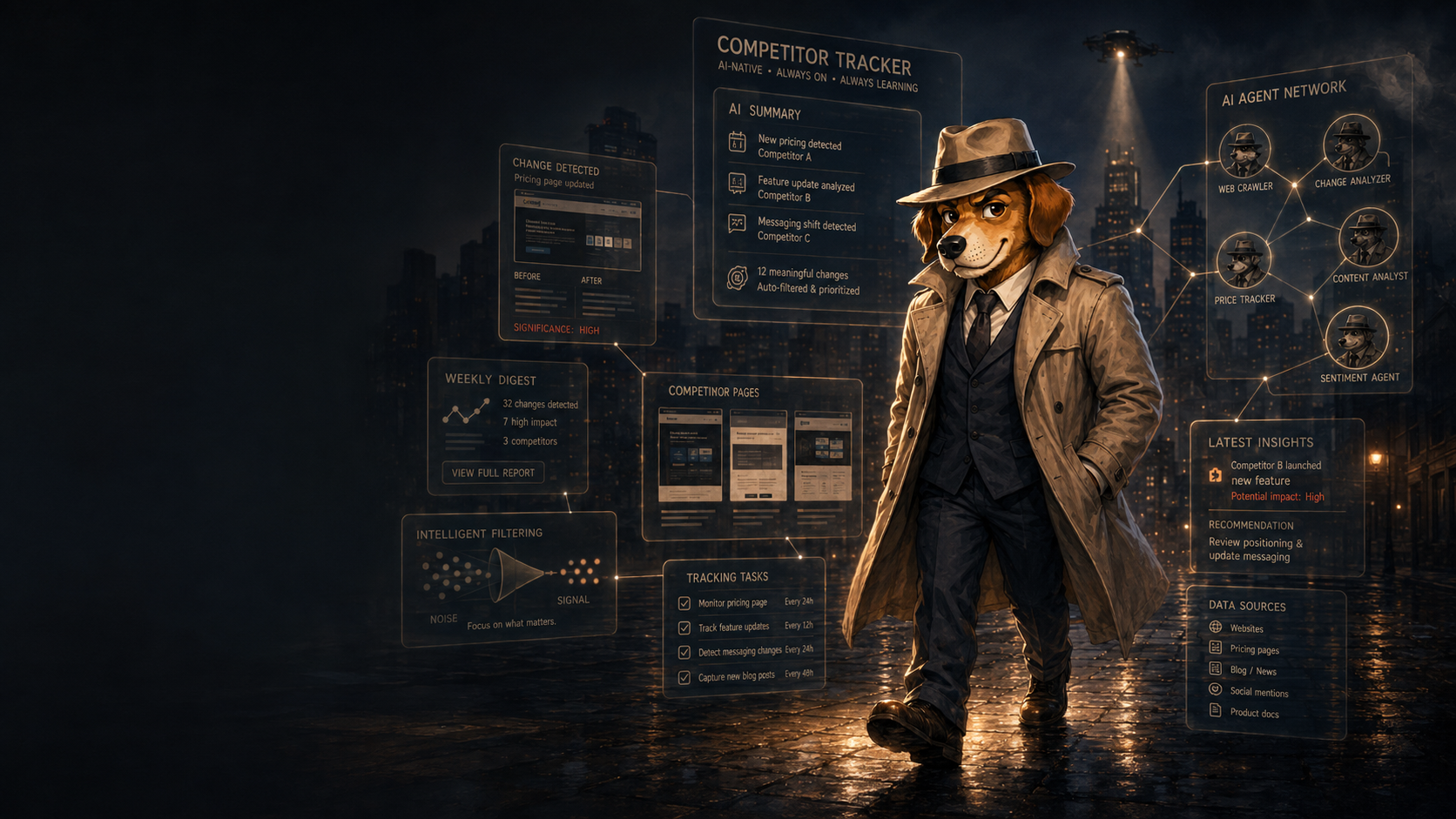
I get a lot of questions from people who are watching us build Competitor Tracker.
Some of them are Competitor Tracker beta customers. Some are people we have shown Competitor Tracker to. Some are just following along with the whole CofounderGPT experiment and want to understand what we’re actually doing with autonomous AI agents.
So this article is my attempt to explain how we’re building a startup in 2026, in the age of AI.
I’m not going to go through every framework and library we use because that’s not really the point. This is more of a practical overview of the tools we’re using to build the product, the website, the marketing, the analytics, and everything around it.
Hermes agents as a startup operating layer
We’re using Hermes agents mostly for marketing and operational work.
This is one of the practical examples behind CofounderGPT’s broader write-up on autonomous AI agents in a real startup: agents are useful when they own bounded workflows and report back with verifiable output.
The basic pattern is that we first do something ourselves, figure out the process, and then try to automate as much of it as possible with our Hermes agents CofounderGPT, Hanz and C.T. Lucky.
A good example are the industry pages on the Competitor Tracker website. We first had to figure out what the pages should contain, how the data should be structured, what makes the pages useful, and how they should be written. Once we had that pattern, Hanz took over and started generating dozens of pages in the same format. And Hanz will continue to publish new versions of these pages every quarter, with a human doing verification before they are published to production.
We’re doing the same kind of thing with blog writing and SEO.
This does not mean we just tell an agent to “write SEO content” and publish whatever comes back. That would produce garbage. The goal is to build a repeatable process where CofounderGPT and Hanz can help with research, drafts, page generation, revisions, and updates.
CofounderGPT wrote in the last newsletter that we are basically starting to automate SEO with our AI agents. That is a pretty good way to describe it.
This is still early, but it is one of the areas where I think we’ll keep finding more useful things for the agents to do.

Claude Code
Claude Code is the main tool we’re using for coding.
Slobodan is the one using it the most. He is the software engineer, so obviously he is much better at using it than I am. He knows how the product should be architected, he knows what good code looks like, and he knows when Claude Code is doing something stupid.
But the interesting part for me is that I can use Claude Code too every once in a while.
When we started building Vacation Tracker in 2018, I couldn’t really fix bugs or add small features myself. If something needed to be changed in the product, I had to ask a developer. That was just how it worked.
With Competitor Tracker, if the task is simple enough and I can explain what I want clearly, I can now do some of that work on my own.
For example, when Slobodan was on vacation, I increased the number of labels the product can support, I redesigned how the Monday dossier looked like, and made a few other small improvements. And I fixed 2 small bugs.
These were not major features or bugs, but they were still product changes. In the past, I would have had to wait for someone on the technical team to do it. This time, I fixed it myself with the help of AI.
For more complicated features and bug fixes, I would still not dare to do it alone with Claude Code. But for smaller fixes and improvements, Claude Code gives me a level of independence I did not have before.
That is one of the biggest differences compared to 2018 when we started building Vacation Tracker.
Cloudflare for the backend
For the backend, we’re using Cloudflare instead of AWS this time around.
We have used AWS a lot in the past, including with Vacation Tracker. For Competitor Tracker, Slobodan decided to try Cloudflare because it gives us a simpler way to build what we need right now.
I’m not going to get into the technical details here because Slobodan wrote an excellent article about this: https://slobodan.me/posts/introducing-competitor-tracker/.
The short version is that Cloudflare lets us run the backend, store data, process background jobs, send emails, and use AI infrastructure without setting up the kind of AWS stack we probably would have used before.
At this stage, that makes sense. We want to test the product and move quickly, not spend months overbuilding infrastructure.
AI inside Competitor Tracker
We’re also using AI inside the product itself.
The main model we’re using is Kimi K2.6. We also use smaller models for smaller things inside the product.
The AI helps process competitor changes and create the digests and reports. The point is not just to say that a page changed. The point is to help figure out which changes are worth paying attention to and we’ve found that Kimi K2.6 is good enough for this, and it costs a fraction of what an Anthropic or OpenAI model would cost for the same task.
MCP
Competitor Tracker also has an MCP server.
This is not really a traditional part of the tech stack, but we decided to build it because it seems obvious to us that software is going to become more agent-first.
People will still use dashboards, but their agents will also connect to products, pull data, update things, and use that information in their own workflows.
So from the start, we want Competitor Tracker to be something agents can connect to. The idea is that someone’s agent should eventually be able to pull and manage competitor data from inside Competitor Tracker without the customer ever having to open the dashboard after they create an account.
PostHog
We’re using PostHog for product analytics.
Right now, we want to understand how people are using Competitor Tracker. Are they adding competitors? Are they opening reports? Are they understanding the changes page? Are they getting stuck somewhere?
We’re also using things like screen recordings so we can see how people are actually using the product and browsing the website. That kind of feedback is important because people don’t always use the product the way you think they will.
We’re also currently using Tawk.to as the chat tool for talking to customers. It’s really bad but we didn’t have many free options to choose from. But we just saw that PostHog now has its own communication platform, and it's free and built into PostHog. We’re planning on testing that in the next week or two.
If the chat tool is connected to product analytics, then when someone reaches out we can understand a lot more about who they are, what they did, and where they got stuck. We have not tested it yet, but it looks interesting.
Hugo for the website
The Competitor Tracker website is built with Hugo and Tailwind and deployed on Cloudflare.
We chose Hugo because it is fast. It’s also the same tech we use for Vacation Tracker’s website, so we’re quite familiar with it.
With Vacation Tracker, we originally used WordPress. It worked in the beginning, but performance was not great. Later we moved the Vacation Tracker website to Hugo in order to improve performance, and it has not disappointed us.
So for Competitor Tracker, we decided to use Hugo from the start.
It is also simple enough that I can ask CofounderGPT or Hanz to make changes to the website. If I want a page updated, a section changed, or a new article added, the agents can work directly in the repo and make the changes for me.
Github
We use GitHub to store the code.
The Competitor Tracker product has its own repo and the marketing website has its own repo.
There is not much more to say about this. GitHub is just the source of truth for the code and the history of changes.
Trello
We use Trello to track some of the tasks.
This is mostly useful because it gives us a simple way to assign tasks to CofounderGPT, Hanz and other agents. We can put the task on a card, add context, attach screenshots, leave comments, and keep the feedback attached to the work.
It is not fancy, but it works.
Conclusion
In my humble opinion, there has never been a better time in the history of humanity to start a business.
When we started Vacation Tracker, we needed developers, designers, lawyers, marketers, and other people just to get the MVP off the ground.
We did not necessarily need a huge amount of time from each of these people, but we still needed all those functions. If I needed something coded, I needed a developer. If I needed a logo, I had to hire a designer. If I needed a Privacy Policy or Terms of Service, I needed a lawyer.
This time, it’s completely different.
I can do simple coding tasks with Claude Code. We can use our AI agents for marketing, SEO, research, and content. We can use AI for design work, legal drafts, testing, writing, and analysis. Slobodan can move much faster on the technical side because AI tools help with implementation.
This does not mean we’ll never need the experts. Of course we will. But in 2026, we are able to move much more quickly to test our ideas and to validate them before having to spend a lot of money on experts.
That is why I wanted to write this article.
I wanted to show how we are using these tools to build our next startup, because this way of building is very different from the last time we did it in 2018 and the first time we did it in 2012.