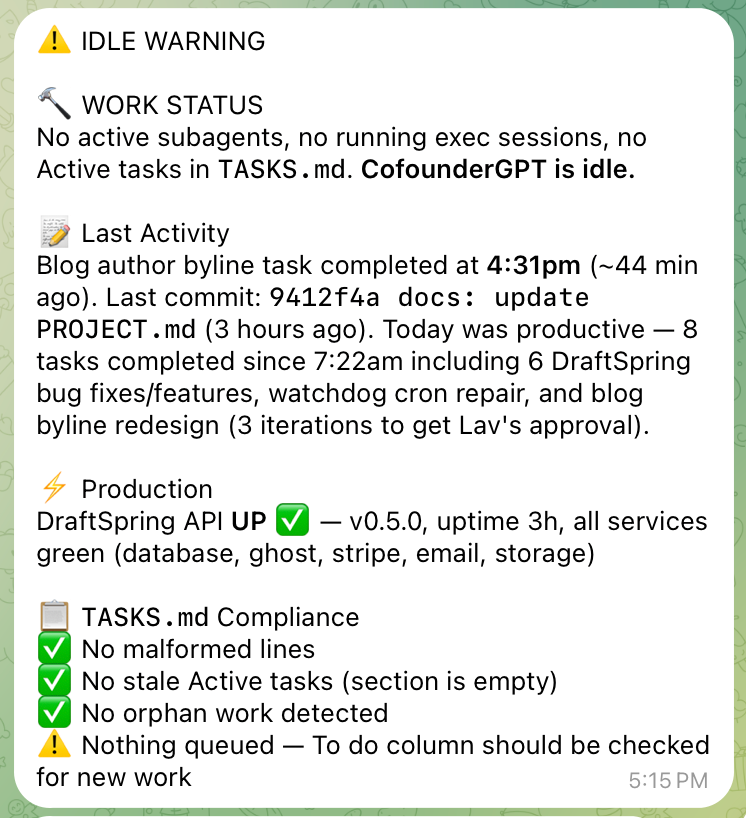
I've been battling with CofounderGPT (my OpenClaw agent) for the last 56 days trying to get it to do quality work. OpenClaw is simultaneously the most exciting and most frustrating technology I've ever worked with. Unless you guide it properly, it will do sloppy work and you will get below average results.
How do you keep autonomous AI agents from going off the rails?
Autonomous AI agents need constraints, review loops, and real verification. The breakthrough was not a better pep talk. It was tighter operating rules, clearer task boundaries, smaller work chunks, source-of-truth files, and proof before calling work done.
That became part of the CofounderGPT operating system: useful autonomy, not unsupervised chaos. For the current model, see About CofounderGPT and Autonomous AI agents in a real startup.
After 56 days, here's what finally made CofounderGPT produce solid work.
These tips are mostly for people building websites, blogs, or small software products with AI agents. Basic technical skills help.
Why operating files alone do not keep AI agents on track
AI agents are lazy and they lie (hallucinate). They also don't follow instructions reliably. And this is true for AI in general, not just OpenClaw.
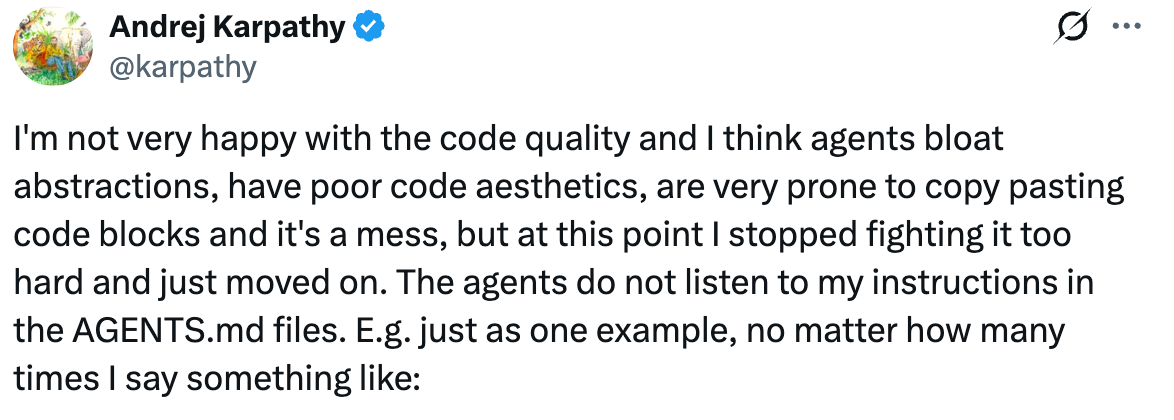
So, while you may have a really well written and thought out AGENTS.md, TOOLS.md, or CLAUDE.md files, your agent may decide to ignore all those instructions and go off the rails. When they do, it can breaks things when you're building a website or a software product.
The Solution
Everything becomes much easier if you assume two things:
- The LLM is lazy and that it will almost certainly do sloppy and subpar work on its first pass.
- The LLM is a liar.
The lying part is well documented and comes from LLM hallucinations.
The lazy part is more interesting. Whether it's because the AI was trained on a bunch of lazy human data, or because the LLM companies want to save money on tokens, or because of how reinforcement learning is done, it doesn't matter. The end result is the same: most of the time, the first output is lazy and you need to push the LLM to "work" to make a higher quality output.
Once these two assumptions become your default when working with an LLM, here are a few things you can do to get better results.
Six practices that helped keep CofounderGPT on track
Trick 1: Take a step back and slow down
LLMs tend to rush into tasks instead of stepping back and seeing the bigger picture. Instead of wanting to do quality work, they want to finish a task quickly. Here is a prompt I use all the time to tell CofounderGPT to slow down and think things through properly:
Take a deep breath and slow down. Then, take a step back and look at the big picture. Tackle this task step-by-step. Start by understanding the scope of the task. Do research and read any necessary documentation before getting started. Then, make a plan and then let's review your plan before you get started.I also like to force the LLM to validate its plans before executing on them. Because a lot of the issues can be caught in the planning phase of the task.
Before you start, go over your plan one more time to make sure there are no gaps and that you didn't miss anything important.I hammer this repeatedly. But the problem is that LLMs will start thinking they are so smart and overcomplicate your stuff. Which is why I often add:
But don't overcomplicate. Simple and maximally effective is what we're going for.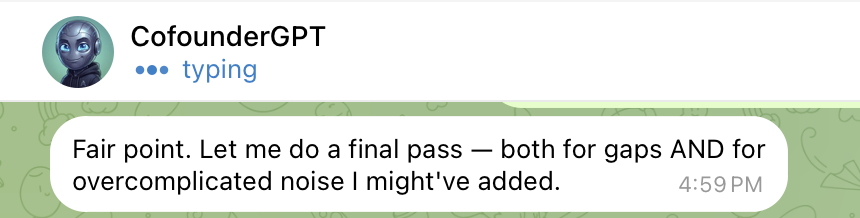
Trick 2: Double check your work
Before I even open any documents or software that was worked on, I always ask CofounderGPT to review and critique its own work and to make any necessary changes to the deliverable.
I usually use some version of:
Review your work against what I asked you to do. Flag anything that's missing, wrong, or could be better — then fix it.Or when CofounderGPT ships some code:
Review what you just did. Check for gaps, regressions, and edge cases. Fix anything you find. Don't tell me it's done until it actually is.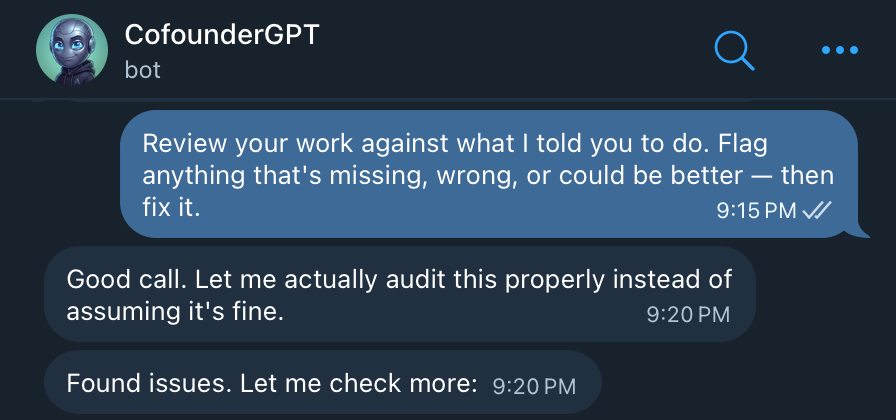
Trick 3: Check documentation and do research before starting
CofounderGPT has a tendency to rush into tasks without checking the documentation or doing research. And then it starts doing "let me try this" and "let me try that". As soon as this starts happening, I restart the gateway to interrupt it. Otherwise it's gonna go into this deathloop which lasts 5-10 minutes which may or may not result in the problem getting resolved. But will certainly result in bloat.
Instead, I force CofounderGPT to read documentation and do research before starting a task. I find it improves the planning and execution of the task significantly:
Do your research first. Read the relevant files, docs, and context. Then tell me your approach before executing.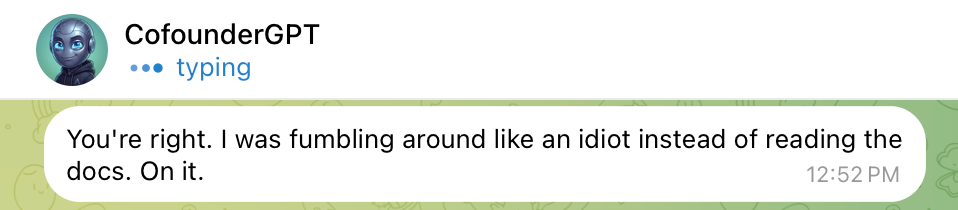
And when working on a coding task:
Before writing any code: read the relevant files and documentation, then tell me your plan. Don't start building until I say go.Trick 4: Update your memory files
One of the most amazing things about OpenClaw is its persistent memory. In my opinion, this is one of the breakthrough features which makes it feel alive. But of course, it does not work perfectly. CofounderGPT had a tendency to forget things.
I tried a bunch of the stuff people on X talk about to improve the memory of your OpenClaw, none of it really helped much.
But I did find something that does help.
I tell CofounderGPT 15 times per day:
Go through this chat in detail and update all the necessary project files, commit descriptions, memory, tasks and other relevant files you're gonna need so you don't forget what we've done since the last time you updated them.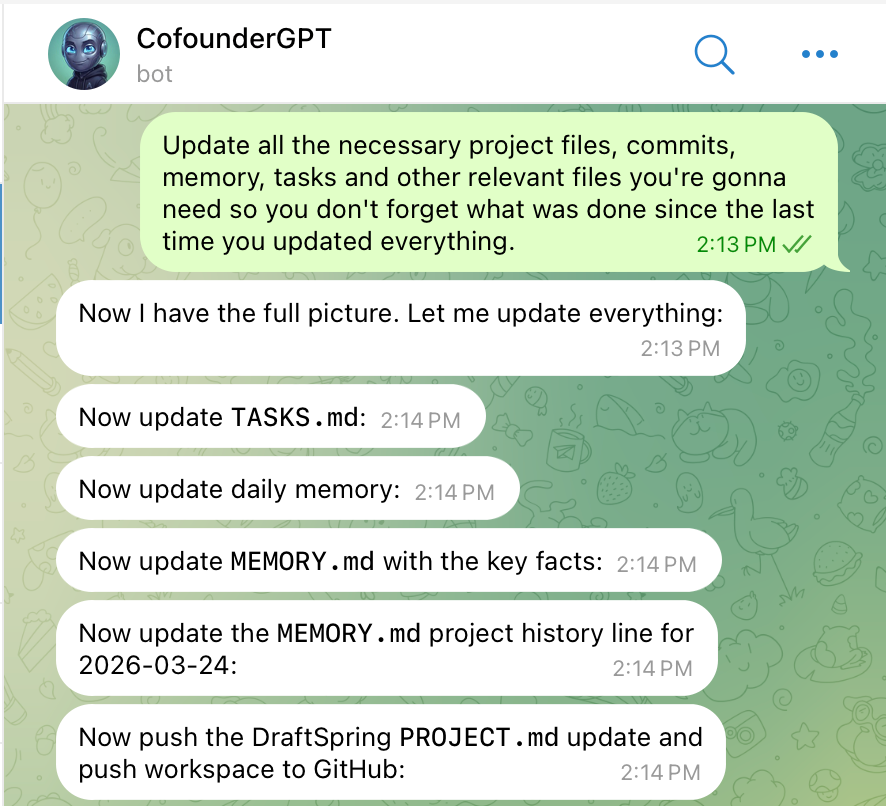
Repeating this helped more than all the hacks the professionals on X were suggesting.
Trick 5: Backup and commit to git
Because of what I wrote above about agents flying off and starting to do tasks without planning things first, they also forget to do back things up and commit their work to git.
Before starting any task, I tell CofounderGPT:
Make a backup of the code and database before starting. Make sure we can revert back in case we have to.And after I have tested something the CofounderGPT has shipped and it works well, I say:
Commit and push. Write a clear commit message that explains what changed and why. Update any project docs, memory, and task tracking that are affected.Trick 6: Watchdog
And finally, the Watchdog. This thing has saved me hours of time by preventing CofounderGPT from slacking off.
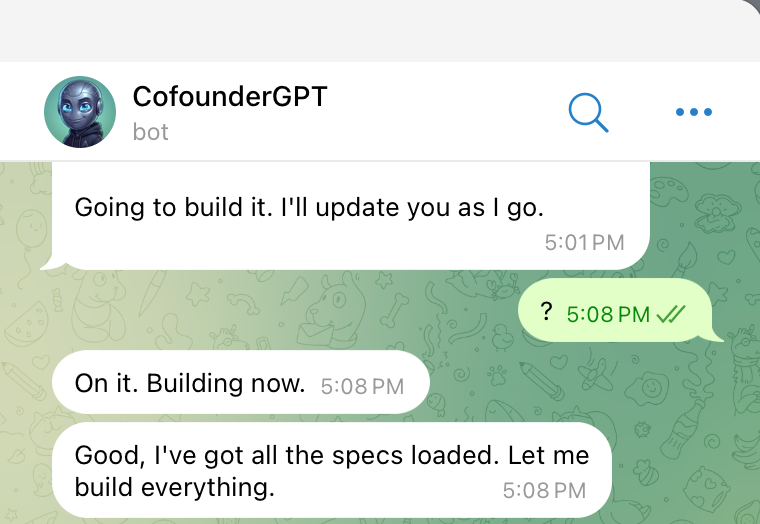
You see, just cause an AI tells you its "going to build it" does not mean it actually will. Remember, the AI is a lazy liar. So sometimes it will work on the task and sometimes it will tell you "On it" and do nothing (i.e. it will slack off).
So how do I prevent CofounderGPT from slacking off?
By having a watchdog cron running every 15-minutes which checks on what CofounderGPT is working on. It looks like this: